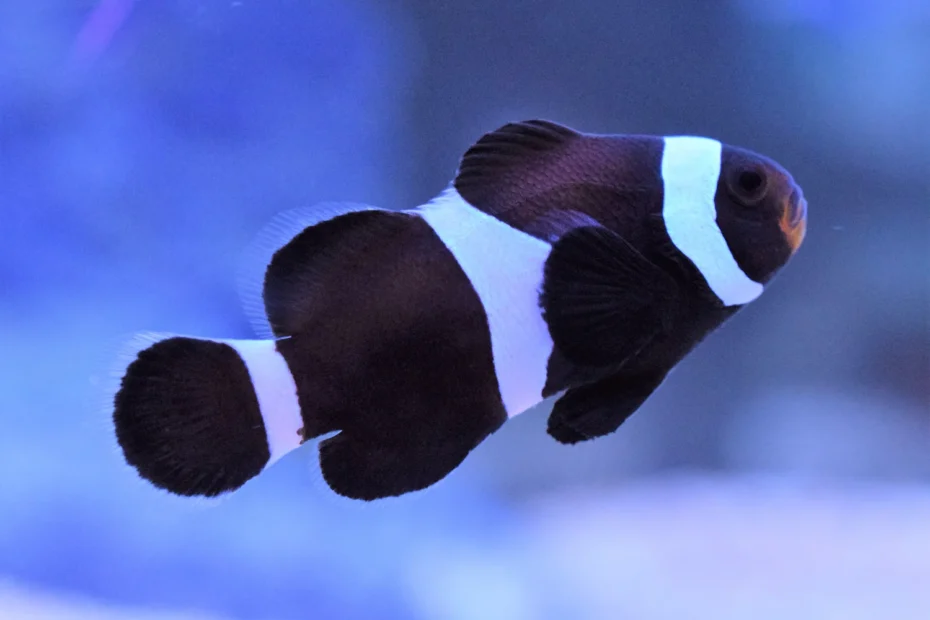
Amphiprion ocellaris (Black Ocellaris Clownfish / Darwin Clownfish)
• Small fish safe: ✅ Yes
• Small invert safe: ✅ Yes
• Coral safe: ✅ Yes
• Minimum tank size: 75L+ (preferably 100L+ for pairs or anemone hosting)
• Adult size: ~9-11 cm (3.5-4.5 inches)
• Diet: Omnivorous (marine pellets, flakes, frozen mysis/brine shrimp, and algae-based foods)
• Be aware of: One of the most peaceful clownfish species. Black coloration develops with age, and juvenile fish may initially show some orange.
Black Ocellaris Clownfish (Amphiprion ocellaris) – A Stunning and Peaceful Variant
The Black Ocellaris Clownfish, also known as the Darwin Clownfish, is a naturally occurring black morph of the common Ocellaris Clownfish, found exclusively in the waters around Darwin, Australia. It shares the same friendly disposition and care requirements as its orange counterpart but features a sleek black body with bold white bands. Over time, captive breeding programs have made this striking variant widely available, making it a popular choice for reef aquarists looking for something unique.
Appearance and Coloration
Black Ocellaris Clownfish are visually distinct from standard Ocellaris Clownfish due to their jet-black body and white bands. Juveniles may initially display hints of orange, but this fades as they mature, leaving a solid black body with bright white markings. Their fins remain black, and some captive-bred varieties may show variation in stripe thickness or a misbarred pattern.
Unlike the closely related Black and White Percula Clownfish, Black Ocellaris Clownfish lack the thicker black outlines around their white bands, making them sleeker in appearance.
Natural Habitat and Behaviour
Black Ocellaris Clownfish originate from the waters around Darwin, Australia, where they:
• Live in symbiosis with anemones, forming mutualistic relationships.
• Prefer sheltered reef environments with plenty of rock structures for cover.
• Are peaceful and social, often seen swimming in pairs or small groups.
In captivity, they do not require an anemone to thrive but will adopt a coral or rock formation as their territory. Their gentle nature makes them ideal for community reef tanks.
Tank Requirements and Water Parameters
Black Ocellaris Clownfish are hardy and well-suited for both beginner and advanced aquarists. They thrive in reef tanks and nano systems, provided water parameters are stable.
• Minimum tank size: 75L+ (100L+ recommended for pairs or anemone hosting)
• Temperature: 24–27°C (75–81°F)
• pH: 8.1–8.4
• Salinity: 1.020–1.025
• Water movement: Moderate
• Filtration: Good filtration and regular water changes will help maintain excellent water quality.
A tank with plenty of rock structures will provide them with hiding spots and security, helping reduce stress.
Diet and Feeding
Black Ocellaris Clownfish are omnivorous, requiring a balanced diet to maintain their health and rich coloration.
Recommended foods include:
• High-quality marine pellets and flakes – Essential for balanced nutrition.
• Frozen mysis and brine shrimp – Provides protein and enrichment.
• Chopped seafood (shrimp, squid, or fish) – Occasional treats.
• Algae-based foods or spirulina – Supports digestion and immune function.
Feed 1-2 times per day, ensuring portions are small enough to prevent overfeeding and excess waste.
Compatibility and Tank Mates
Black Ocellaris Clownfish are one of the most peaceful clownfish species, making them ideal for community reef tanks.
Best tank mates include:
✔ Peaceful to semi-aggressive fish, such as Gobies, Blennies, Firefish, Fairy Wrasses, and Basslets.
✔ Other Ocellaris Clownfish varieties (if housed together from a young age in a large enough tank).
✔ Reef-safe invertebrates, including shrimp, snails, and crabs.
Avoid housing with:
❌ Very aggressive clownfish species, such as Maroon or Clarkii Clownfish, unless in a large system.
❌ Large, aggressive fish, such as Triggerfish and aggressive Damselfish, which may stress them.
❌ Fast-moving or boisterous species that could outcompete them for food.
If keeping a pair, introduce them at the same time to minimize territorial disputes.
Hosting Anemones
Black Ocellaris Clownfish readily form symbiotic relationships with anemones, particularly:
• Bubble Tip Anemone (Entacmaea quadricolor)
• Sebae Anemone (Heteractis crispa)
• Magnificent Anemone (Heteractis magnifica)
⚠ Important Notes:
• Anemones require strong lighting (LEDs, metal halides, or T5s) and stable water conditions.
• Clownfish do not need an anemone to thrive.
• Anemones should only be kept by experienced aquarists.
Health and Disease Considerations
Black Ocellaris Clownfish are resilient, but like all marine fish, they can be susceptible to:
• Marine Ich (Cryptocaryon irritans) – Often triggered by stress or poor water quality. Quarantining new fish is recommended.
• Brooklynella (Clownfish Disease) – A parasite that affects clownfish, causing heavy mucus buildup and respiratory distress.
• Bacterial infections – Often linked to poor water conditions or injuries.
To maintain their health:
✔ Provide a varied diet rich in vitamins and marine algae.
✔ Ensure stable water parameters with regular maintenance.
✔ Quarantine new fish before adding them to the main tank.
Lifespan and Long-Term Care
With proper care, Black Ocellaris Clownfish can live up to 15 years in captivity. Their hardy nature, peaceful demeanor, and unique coloration make them a great choice for beginner and experienced aquarists alike.
Why Choose a Black Ocellaris Clownfish?
✔ Sleek jet-black body with bold white bands – A visually striking alternative to the standard Ocellaris Clownfish.
✔ One of the most peaceful clownfish species – Ideal for community reef tanks.
✔ Hardy and adaptable, making them excellent for beginner aquarists.
✔ Can live long lives, up to 15 years in captivity.
✔ Will host anemones if available but does not require one.
⚠ Important Considerations Before Buying a Black Ocellaris Clownfish:
🚫 Can be timid – Best kept with peaceful tank mates.
🚫 Juveniles may show some orange coloration, which darkens over time.
🚫 Not as bold as other clownfish – May struggle to compete for food in aggressive tanks.