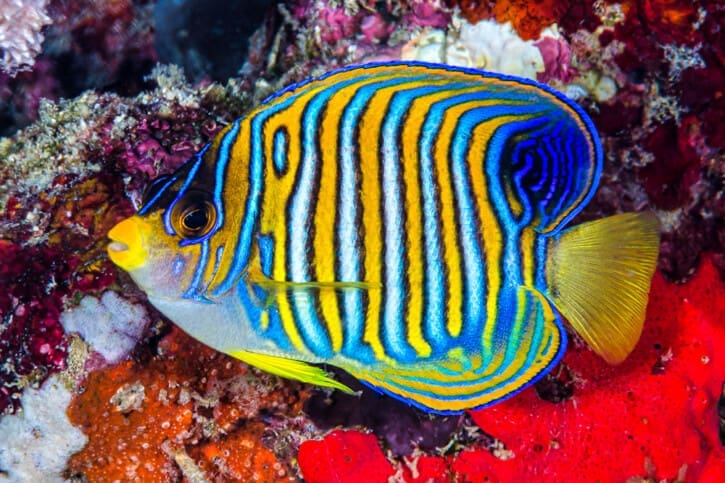
The Regal Angelfish (Pygoplites diacanthus), also known as the Royal Angelfish, is a visually striking marine fish celebrated for its vibrant coloration and graceful presence. Found throughout the Indo-Pacific region, it is a sought-after species among marine aquarists.
Key Information
• Small fish safe: ✅ Yes
• Small invert safe: No
• Coral safe: No
• Minimum tank size: 475 liters (125 gallons)
• Adult size: Up to 25 cm (10 inches)
• Diet: Omnivorous, with a strong preference for sponges and tunicates; may also accept mysis shrimp, brine shrimp, and specialized angelfish preparations containing sponges.
• Be aware of: May nip at corals and small invertebrates; requires a well-established tank with ample live rock for grazing and hiding spots; can be shy, especially in brightly lit tanks or when housed with aggressive tank mates.
Appearance and Coloration
The Regal Angelfish is renowned for its stunning coloration:
• Body: Features narrow, vertical stripes of blue, white, yellow, or orange that angle backward.
• Fins: The posterior portion of the dorsal fin is black or blue with close-set blue dots, while the anal fin displays alternating yellow and blue bands running parallel to the body contour. The caudal fin is yellow.
Notably, regional variations exist: specimens from the Red Sea and Maldives often exhibit a distinctive yellow breast, whereas those from the Indo-Pacific regions may have a blue or gray breast.
Natural Habitat and Behavior
In the wild, Regal Angelfish inhabit coral-rich areas of lagoons and reefs, often near caves, at depths ranging from shallow waters to 80 meters. They are typically solitary or found in pairs, with juveniles often sheltering in crevices. Their diet primarily consists of sponges and tunicates.
Tank Requirements and Water Parameters
To ensure the well-being of the Regal Angelfish in captivity:
• Minimum Tank Size: A 125-gallon (475 liters) aquarium is recommended to provide ample space for swimming and territory establishment.
• Water Parameters:
• Temperature: 72°F – 78°F (22°C – 25.5°C)
• pH: 8.1 – 8.4
• Specific Gravity: 1.020 – 1.025
• Aquascaping: Incorporate plenty of live rock to create hiding spots and grazing areas, mimicking their natural reef environment.
• Lighting: Moderate lighting is suitable; overly bright lighting may cause shyness.
• Water Movement: Moderate flow to simulate their natural habitat.
Maintaining stable water conditions and high water quality is crucial for their health.
Diet and Feeding
Regal Angelfish are omnivorous, with a strong preference for sponges and tunicates:
• Diet: Offer a varied diet consisting of:
• Sponges and tunicates (available in specialized angelfish preparations)
• Mysis shrimp
• Brine shrimp
• High-quality marine pellets
• Feeding Frequency: Feed small amounts multiple times daily to meet their nutritional needs.
Providing a diet rich in marine sponges is essential, as they form a significant part of their natural diet.
Compatibility and Social Structure
Regal Angelfish can be shy, especially when first introduced or housed with aggressive tank mates:
• Social Structure: Best kept singly unless in a very large aquarium where multiple individuals can establish territories.
• Temperament: Generally peaceful towards other species but may become shy or reclusive if housed with aggressive fish.
• Compatible Tank Mates: Suitable companions include peaceful community fish such as gobies, blennies, and wrasses. Caution is advised when housing with more aggressive species.
Observing their interactions and providing ample hiding spots can help reduce stress and encourage natural behaviors.
Important Considerations
• Reef Compatibility: While often considered reef-safe, individual specimens may nip at corals and small invertebrates. Monitoring their behavior is essential, especially in reef setups.
• Acclimation: They may be shy upon introduction but typically become more confident over time.
• Health: Ensure a varied diet and stable water conditions to prevent common health issues.
With proper care and attention to their specific needs, Regal Angelfish can be a vibrant and rewarding addition to a marine aquarium.