Common Clownfish
20 in stock
£25.00
Description
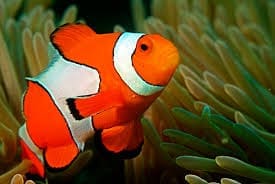
Amphiprion ocellaris
- Small fish safe: yes
- Small invert safe: yes
- Coral safe: yes
- Minimum tank size: 76L
- Adult size: 7.6cm
- Diet: Herbivore
Be aware of: N/A
The Common Clownfish is, quite understandably, an all-time favourite amongst many marine aquarists on account of its captivating personality and vibrant colouration. In the wild, clownfish are afforded lifelong protection from predators and skin parasites by a host anemone; Common Clownfish being most commonly associated with the Ritteri anemone (Heteractis magnifica), Stichodactyla gigantea, and S. mertensii.
In the mixed reef aquarium, a host anemone – some of which can be a little tricky to maintain successfully in captivity – is not necessary for your clownfish as most reef set ups contain plenty of hiding places, no large predatory fish, and sometimes cleaner shrimp/cleaner wrasse. In the absence of an anemone, some clownfish take up residence in what they see as a suitable coral substitute – which may cause them to retract in irritation as the clownfish wallow – but this isn’t always the case.
Many species of clownfish (including the Common) are now captive-raised, so wherever possible the conscientious aquarist should aim to source these hardier specimens for the home aquarium, in turn helping to take pressure off the reefs. As these fish can be quite territorial, in the average sized aquarium you should aim to keep just one known pair.
In larger tanks, more than one pair could be kept if they are all added at the same time as juvenile specimens and plenty of visual barriers are provided amongst the decor (or in the case of adding host anemones, enough anemones for all the fish, added at the same time as the clowns). If shelters are limited, the dominant clownfish will bully the others, picking them off one-by-one, so careful observation is necessary. Bear in mind that catching fish out of an established reef tank can be extremely difficult, so think carefully about adding more than one pair to your set up! It is also best not to mix this species with other species of clownfish as many will fight.
With regards to sexing, all clownfish are born as males. A wild colony may consist of a breeding pair, which cohabit with a few non-reproductive smaller male specimens. When the female dies, the dominant male will change sex and become the female. This is known as protandrous sequential hermaphroditism. In the case of two juvenile specimens in the home aquarium, the larger of the two will become the female.
Finally, do not attempt to house Common Clownfish with the Atlantic Carpet anemone (Condylactis sp.) as they may be consumed, and be aware that these fish are very sensitive to treatment with copper remedies. A tank-raised black and white colour variant of this species is often also available. May also be seen on sale as the False Percula Clownfish.
Only logged in customers who have purchased this product may leave a review.
Related products

Visit us
Unit 4 Lacewing link, Hamstreet, Kent, TN26 2DZ
Opening times:
- Monday: Closed
- Tuesday: 4pm to 8pm
- Wednesday: 4pm to 8pm
- Thursday: 4pm to 8pm
- Friday: 4pm to 8pm
- Saturday: 10am to 7pm
- Sunday: 10am to 5pm
Login
Register
5 Star Pet License Holder: A001204412
Reviews
There are no reviews yet.